“I will not let Haemophilia take over my life” says a Student

By: Lindokuhle Mnisi

@LindokuhluMisi


To some it is embarrassing to publicly disclose one’s self health condition. The fear of being isolated, insulted, criticised and judged is the reason why many people find it difficult to speak out about their health status. But all that didn’t prohibit Paseka Menyau from speaking out about his haemophilia condition.

Menyau (22), a 2nd year journalism student, has been living with this rare disease (haemophilia) for his entire life. He encountered countless life threatening situation which resulted to him being hospitalized. “I was once in a life threatening situation in 2002 when I got involved in a gang attack. My head was hit with a stick and I had headache for two weeks. I got admitted in ICU but luckily they didn’t perform operation,” he said.

“I had a problem with my left knee. I was playing soccer and I got injured. It started swelling spontaneously. I would take my medication and after a certain time it would start swelling again,” he added.

Menyau joined the South African Haemophilia Foundation (Central Region) in 2011 and has been a vocal member since then. He has been addressing various organized meetings regarding this condition. On the 16th April he was interviewed on TV, 3Talk with Noeleen on SABC3, and on the 17th April (World Haemophilia Day) he was addressing people at the Steve Biko Academic Hospital. Other meetings that he is invited to address is in Polokwane Provincial Hospital and Dr George Mukhari Hospital in Ga-Rankuwa.

Around September he invited to visit America but details are still to be confirmed.

On TUT-FM (Live@6) he spoke about some of the challenges that haemophilia patients faces due to the lack of knowledge about the condition in townships. “People think if you have haemophilia you will die. People start treating you differently like you are really disabled and dying in 2days,” he said.

“Haemophilia may be dangerous but if you take your medication correctly you won’t suffer,” Menyau warns.

Many people doesn’t know what haemophilia is, this is the definition

Haemophilia:

An inheritable disease, usually affecting only males but transmitted by women to their male children, characterized by loss or impairment of the normal clotting ability of blood so that a minor wound may result in fatal bleeding.


Successful Freedom Day Celebration

By: Lindokuhle Mnisi
@LindokuhleMnisi

Deputy Pres. Kgalema Motlenthe, Pres. Joyce Banda and Pres. Jacob Zuma


The 18th Freedom Day celebration was held successfully at the Union Buildings, in Pretoria, where the president of the SA Republic,Mr. Jacob Zuma, and other distinguished guests gathered on Friday.

Among those who attended the event was Malawian (interim) president Joyce Banda. From South Africa was Deputy President, Kgalema Motlanthe, Chief Justice Mogoeng Mogoeng, deputy speaker of the National Assemby, Ms Noma India Mfekelo, Deputy Chairperson of the NCOP, Ms Thandi Memela, Minister of Art and Culture, Mr Paul Mashatile, the Mayor of Tshwane, Mr Kgosientso Ramakgopa and other ministers, deputy ministers and MECs.

President Zuma delivered a speech which guaranteed progress of unity, freedom, democracy, non-racial and non-sexism in South Africa since 1994 to 2012. This year’s Freedom Day theme is “Working together to Build Unity and Prosperity” and Zuma said “It takes into account our strong focus on boosting inclusive growth and prosperity. It also underscores the focus on heritage and the celebration of unity through celebrating the heroes of our struggle for freedom, to whom we owe so much”

Zuma honoured freedom fighters and heroes (black and white, and women) who have made it possible for South Africans to defeat the apartheid regime and gain freedom for all. He referred and quoted variety of the past activists and freedom fighters, which includes Lillian Ngoyi, Chief Albert Luthuli, first black President of the Republic of South Africa Nelson Mandela, former ANC president OR Tambo, General Smuts, Braam Fischer, Father Trevor Huddlestone and Ruth First.

“We recall today that our freedom was gained through blood, sweat, and tears. It is through the blood of the people of Sharpville, Soweto, Langa, kwaMashu, kwa Zakhele, Mdantsane, and many other areas, that we gained our freedom and equality,” said Zuma.

The venue, where the event was held, was crowded with an estimated number of more than 10 000 people who clapped hands and screamed for excitement when a compliment was granted to the Constitution of South Africa.“Our Constitution is among the best in the world with equality clauses, which guarantees equality before the law, right to life, and human dignity, right to privacy, freedom religion, belief and opinion, freedom of expression, freedom of association and freedom of assembly, demonstration, picket and petitions,” said Zuma.

According to the President, a lot has been achieved in the extension of basic services since 1994, in turning South Africa around, but much more still needs to be done. The past 18 months have seen substantial recovery. In 2011 alone, employment grew by a thousand jobs a day; investments climbed by 4%; and the GDP grew by just over 3%.

The proportion of population living below a R422 a month poverty line decreased from 50% in 1994 to 34.5% in 2009.

In education, school enrolments have drastically improved since 2003 and 8.8 million learners have been put on the nutrition programme. R8.2 billion have been allocated for school infrastructure.

In 1994, only 62% of households had access to running water, and the figure have risen to 94.5%. With regards to water infrastructure, forty-regional bulk projects will be completed by 2014, benefiting 3.2 million people.

In 1994, only 50% of households had access to decent sanitation, which has now risen to 82%.

By 2011, 75.8% of households had access to electricity, a huge improvement from 51% in 1994.

With his closing remarks, President Zuma made special reference to some of the ANC presidents who led the struggle for liberation over many years ago. “As a country we will honour the following former presidents of the ANC with National Orders Awards, Chief Albert Luthuli, Oliver Regionald Tambo, Sebe Moroka, A.B Xuma, Pixley ka Isaka Seme, Zac Mahabane, Josiah Gumede and Sefako Makgatho, for their outstanding role in ensuring that our country became a free and democratic society,” said Zuma.


Mayor of Tshwane, Kgosientso Ramakgopa saying the vote of thanks

The Mayor of Tshwane took to the podium to say the closing remarks (voice of thanks) to everybody who attended the celebration and thanking the three organs of state institutions (government, judiciary and the legislature). He said their presence is “…to confirm that indeed this is a national celebration”.

“Today marks the occasion of the celebration of the birth of democracy in this country and we find it appropriate that this celebration is taking place on the launce of the Union Buildings, the site of the birth of democracy,” says Kgosientso Ramakgopa.

Life before colonization in South Africa

By Lindokuhle Mnisi
@LindokuhleMnisi


Picture: GOOGLE

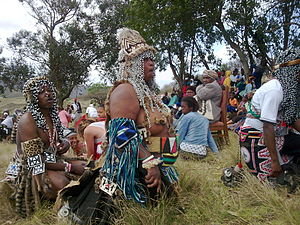
Life before the 1800s used to be totally different from the one we are living today. Africa used to be a unique continent like any others in the entire world. Nobody depended on other people’s ideologies for transformation and better living conditions. Tribes had their own beliefs, culture, religions, and heritage. Africans knew where they belong and understood their standard of life.


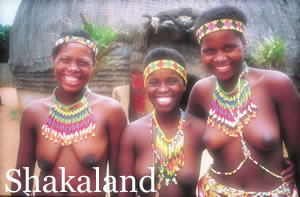
Africans in the sub-Saharan, African, countries believed in ancestors and nature. They knew that when anyone of them got sick/ill they would go to the gardens and get some herbs. They depended on the natural creatures for health, food, etc. They would bow before their ancestors when they needed anything, be it luck, life, wealth, etc. Their dress code was unique and reflected their indigenous culture.

The arrival of the Whites (Europeans, Dutch, Russians, etc) in Africa (South Africa in this matter) changed everything completely. The ideologies they brought to the fore contributed to the abandonment and negligence of African’s indigenous cultures, norms, traditions beliefs and religions. One of the beliefs that came with colonizers is the white religion called ‘Christianity’. It is known and an undisputed fact that Africans believed in ancestors in the past and there was life, then whites came and made them believe that there is a God somewhere who holds, controls and guide human’s lives.

Today the same Christianity is divided because of contradictions and confusions. Those who introduced it to us persuaded us to stop believing in ancestors, saying they do not exist. Some churches still say Ancestors are there while others have completely abandoned that belief. A Bible was brought after Africans were taught how to read and write, it only existed in the Western countries before. Africans depended on their own harvest for a living.

Palliative treatments were used to convince the easy shaken Africans. Blaming the whites only would be a blunder. Africans have softened their hearts and followed everything new that was brought to them. None of them could see that these people came for certain benefits. Blacks can be associated with the word “followers”. It is easy for them to neglect anything indigenous to them and adopt the newly introduced things.


Arabs, in the North African countries, never abandoned what they believed in. They still believe in Allah (As their God) and Islamic religion. That religion has always been theirs forever. Hindus still believe in what they believed in, Jews never neglected their Jewish beliefs and Whites never gave up their Christianity but Africans (blacks) neglected their ancestral beliefs and continued the legacy of Christ.

I wish people would go back to the times of Shaka Zulu, and continue believing in what used to work for our fore fathers. Transformation shouldn’t affect our beliefs and leave us scattered in imperialists’ religions. Africa is for those who live in it...


 Press freedom will never be under threat in South Africa, Nelson Mandela says but it's not practical.

By Lindokuhle Mnisi

@LindokuhleMnisi

“Press freedom will never be under threat in South Africa for as long as the ANC is the majority party” Nelson Mandela.

The South African Constitution is yet facing another threat of being destroyed by the very same people who created it (SA ruling party, ANC). ANC has been up trying to implement a BILL that intends to regulate the classification of state information, protection and dissemination of state information, weighing state interests up against transparency and freedom of expression. That is how the ANC came up with the Protection of State Information BILL which is commonly referred to as Secrecy BILL.

This legislation has resulted to a whole lot of confusions and controversy as it contradicts with Section two of the South African Constitution, (BILL OF RIGHTS). This attack to the media by the government doesn’t only infringe in the media’s rights but to the citizen’s rights too. While the media is denied access to information; its freedom of expression, freedom of speech and rights of the press are challenged, the citizens suffers the denial of their right to know and be informed. It is their rights that were acknowledged by the ANC when it got in power in 1994 and when the current constitution was drafted in 2006. The BILL was not thoroughly checked for its accuracy and transparency, I still ask my self how it passed through the National Assembly yesterday (22 November 2011) when 229 MPs voted in support and 107 were against and 2 abstained. Mandela said in his quotes that “Press freedom will never be under threat in South Africa for as long as the ANC is the majority party” but what is happening now? Now that he is not in parliament, they do as they please.

The concern here is that the ANC want so severely to turn its back against the voters. The very same people who voted for them are now facing hardships and censorship. Looking at the people in the rural areas, they are always bound to abide by any legislation that is proposed in the Parliament. They are not granted the right to raise their views, to express their sentiments and grievances. Decisions are taken on their behalf, because they only exist during voting times. Yet these laws affect them in one way or the other. As a rural home boy I can assure you that life is not balanced amongst all South Africans and yet not fair, segregation still survive even 17years after Apartheid was defeated. People in the rural remain deprived in every aspect of life. Now my biggest concern in this case is that they don’t come to us to explain the significance of these laws they always lambast us with. In hospitals and public clinics we will be denied answers to any question we will be having.

If a patient dies suspiciously, all whistleblowers will be afraid to expose while the employees will just say “this is state information”. In police stations, dockets will go missing unjustifiably and it will be state information. The councilors will misuse money and again no one will be doing anything to expose that. In the rural we live in destitute and no body does anything about that. We are far form information already; this BILL will make things worse. We don’t have sufficient facilities but now that we cant say anything about that. Who is going to take care of this? Who is going to come and listen to the sentiments in the rural and explain to the government when journalists will be living under threat? The government doesn’t come to us so we sometimes depend on journalists who “sometimes” try to come listen to us. They just abandoned us to the Chief who does nothing to empower our lives.

South Africa is going down. This started unnoticeably with the RICA act; RICA denies us the right of privacy. Every call we make is recorded and listened to by strangers. We are no longer entitled to our own constitutional right (right of privacy), Now there comes the so called Protection of State information Bill, this law affords the Government the right of privacy and keeping secrets. The government wants to remain superior while voters stay inferior. This is just another form of trying to incubate corruption. They argue saying they are trying to fight against irresponsible reporting amongst journalists but in reality they are in a mission of implementing laws that will cover up the corrupt officials within the ruling party.

Everything that happens in our country should be exposed immediately so that people can start planning on how they can drive this to a better country. I got surprised when doing my random interviews and one of my fellow journalism students at the Tshwane University of Technology said “Exposing everything about our Government portrays SA negatively to the international countries” he added by saying “the weaknesses of the country should be protected to maintain it’s image” I was flabbergasted looking at the fact that we, voters, should be denied access to information to benefit the reputation of the government who doesn’t consider our needs. The very same international countries facilitated the distraction of Apartheid now they shouldn’t be aware is happening. Sometimes I feel like the country is going back to Apartheid but this time around the OPPRESSED BECOMES THE OPPRESSOR.

In the economic perspective, these laws are a grim threat to the international investors. Where there is a confusion of laws you will never see investors, and that jeopardize the SA Economy.

Maybe I’m being too broad with this but the point here is that this Protection of State Information BILL is poisonous for our country. It breaks us apart, not fair and logically impracticable. The fines are not fair to the journalists and to the citizens. Being found in position with information that is declared “classified” that person faces chances of being jailed for about 5 to 20 years. That is too harsh. Where is the future of journalism, when journalists are censored then who is supposed to inform the public? Civil Societies, Right2Know campaign, Political parties and other citizens slams the BILL and are still up in the fight against this it. DA leader Helen Zille raised her views saying “The BILL has been reported to the Constitutional Court and that is where it will be demolished”

It is still going to pass through the National Council of Provinces before being signed officially by the president, Jacob Zuma. But it’s clear that he is going to be in favor with it.

Concerns from the SANEF are that if they can change and add at least some clauses in the BILL more specially the Public Interest defense clause. Journalists should have a defense at least.


 Motivations empower the youth.

By Lindokuhle Mnisi

@LindokuhleMnisi

WHAT IS LEADERSHIP?

WHO IS A GOOD LEADER?

WHEN DOES ONE BECOME A LEADER?These are the questions that many people ask themselves and struggle to formulate answers for them. It is enormously hard to tell who and what is a good leader/leadership. People confuse leadership with influence. These is not due to lack of knowledge but because these two things seem to correlate with each other. These may all come from the past, which many people can’t run away from, but that is not the main point, the question still remains as “What is leadership?”

In the past, people used to believe that a leader is a person who makes orders, rules and laws, those with higher powers, those respected and honored for what they are. It didn’t matter whether those (rules, laws, orders etc.) were fair to the people but they had to follow them. African countries were colonized, Kings and monarchies ruled in many African countries and all that was called leadership. Was it really leadership? The question still remains.

In nowadays, people are more literate and can think to decide for themselves. Those people who were referred to as leaders are called dictators. And yes some of them are really dictators. But how do you tell if a person is a good leader or a dictator? Is a role model a leader or an influence? These lead us to the definition of leadership.

Defining leadership

It is the process of social influence in which one person can enlist the aid and support of others to accomplishment of a common task (Wikipedia). This definition leads us to the question, “What is social influence?”

Social influence occurs when an individual’s thoughts, feelings or actions are affected by other people. This influence takes many forms and can be seen as conformity, socialization, peer pressure, obedience, and leadership, persuasion, sales and marketing. People tend to allow influence from liked and respected people (famous celebrities or politicians) even if the influence is extremely negative.

Since leadership can be defined through many different ways, depending on an individual’s perspective, I have also formulated my own definition of leadership.

Lindokuhle Mnisi defines leadership as:

·It is the act of attraction whereby a person persuades another with a certain ideology and influences to get those people following them. The ideology is implanted into the targeted people’s minds, they are therefore convinced about the idea and then they follow. An act of propaganda is also used to “propagandize” people

Positive voice

A single word has the power to lead a number of people, negatively and positively so. It can cause damage by leading people to the wrong path, and that is bad influence. At the same time it can lead some to their destinations, and that is positive influence. Being a good and respected leader takes many years of practice if you are not born as one. It may start within you, your family, friends and peers or the society you live in. People may regard you as a leader even before you notice. But what do you do when you realize that there are people who are learning from you everyday? Do you take advantage and act arrogantly seeing yourself as the best thing on earth? Yes, some do like that only because they do not know what a leader is.

Mothers and fathers have the responsibilities in their hands, the responsibility of taking care of their families and children. But it is more surprising how they abandon their families and take care of their friends, improving their lifestyles to a lavish one. In today’s life, there is no difference between a male and female as they now do tragic things equally. The violence and abuse that happens in homes is a lesson to the children, and a lesson leads people. In this case it is leadership and not a good one. Leaders are everywhere, same as influencers.

Take advantage of the opportunity you have to lead the people, ensure to do it wisely and positively. Lead yourself to the right direction so you can manage to lead other people to the same right direction. It doesn’t matter how old you are, you do not need a deep voice to be or sound like a leader, you just need your brains and the courage to encourage. Don’t use power to get people following and doing what you do but use power to ensure you have the strength to face all challenges you may come across as you lead in your own territory. Everyone is a celebrity in their own territory so avoid taking advantage that people follow your lead.

Last but not least:

Take care of your reputation before taking care of yourself.

Build your name before building your muscles.

Spread the love before loving yourself.

And introspect before you act.


This free website was made using Yola.

No HTML skills required. Build your website in minutes.

Go to www.yola.com and sign up today!

Make a free website with Yola